

#RPGaDay2024
Do I love gadgets? If you look in my kitchen or at my collection of camping gear, you’ll see the answer is a loud ” yes!” If you look at my board games, I organize them all with containers and baggies to ease setup. There, I have a few gadgets. When I think about my RPG hobby, few gadgets can be found. I need to expand on what I consider a gadget and think about gadgets in-game mechanics.
I am preparing to premiere Sentinel Comics, the RPG, on the channel in December. I’ve run some practice sessions to familiarize myself with the mechanics. It is near the top of my list of grossly underrated games. It is the best superhero RPG I’ve seen. When you look at the credits in the book, it’s clear why. You have the people behind the excellent co-op card game set in the same universe, combining powers with clever designers like Cam Banks. The dice system has Cam’s Cortex in its DNA.
The gadget in the mechanics that is great is the Scene Tracker. Every great supers battle in the comics escalates. Does Hulk do his sonic power clap in the first panel? Does Johnny Storm go SUPERNOVA in the second panel? No. The Scene Tracker, at first glance, looks like a round tracker. Once everyone in the scene took their action, a box gets ticked. Not all boxes are the same, though, and there are a set number of boxes.
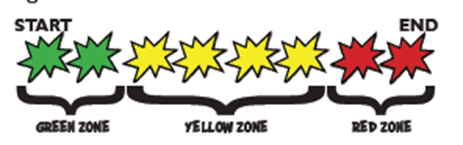
The early boxes are green, the middle yellow, and the final are red. When you take an action as a hero, you gather three dice. One is for your power, the quality (think skill) you will use, and the last is your status die. Each is a different size. You may use your d10 power and d8 skill and have a d6 status. You roll all three and typically use the middle value rolled as your effect die – the die that determines the impact of your action.
The die size of your Status die is set based on being a Green, Yellow, or Red Status. As your hero drops in health, your status moves from Green to Yellow to Red. Some heroes get better as they get hit (Their Red Status die is better than their Green). Some get weaker (Red < Green). Some are stalwarts and have the same die size for each status. Your abilities are also grouped into Green, Yellow, and Red. Your Yellow Abilities are better than your Green ones, and your Red Abilities are your big guns. Even if your Status die doesn’t improve as your Status moves to Red, your Abilities do.
Back to the Scene Tracker, your Status is determined by the farthest progress between your Health and the Scene. If you are unhurt (Green) as the Scene Tracker moves to the final round (Red), your status is RED! If you are beat up (Red) early in the fight (Scene Tracker is still Green), your status is also RED. The tracker escalates the fight as time passes in the battle. In the last few rounds, all heroes, even the unhurt, are Status Red and have access to all their Red Abilities, and their RED Status dies.
Seeing this in play perfectly emulates the genre. Now add to the mix that your environment has GREEN, YELLOW, and RED status. As the fight continues, the twists and threats from where the fight is happening escalate. Meanwhile, while in the Green Status, the First National Bank, where you are stopping a robbery, may add a twist of a blasting alarm, causing your hero to lose focus (a -1 hindrance on your next roll). The twist at red may be the entire building starting to collapse from all the damage and chaos from the fight!
What happens after the last box in the Scene Tracker is checked? The fight ends. If the villains are still up and about, they escape with the money from the vault. Their master plan to blow up City Hall succeeds, or they make off with the mayor!
The Scene Tracker helps create the escalating tension in a superhero battle. It is a beautiful gadget and a perfect example of mechanics that support play.




Leave a Reply